
HARDWIRED FOR SPEED
Network Wiring & Ethernet Runs in San Diego
Hardwired Ethernet to the TVs, desks and access points that need the fastest, steadiest connection, with Cat 6 or Cat 6A cable run inside the walls.
Quoted by the run
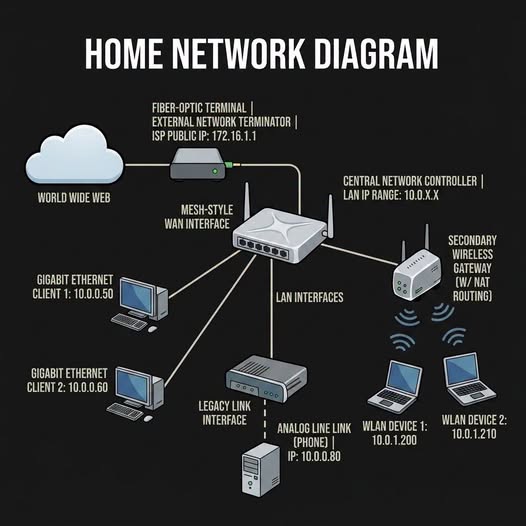
Network wiring services
- Cat 6 or Cat 6A Ethernet runs inside the walls
- Wall jacks at TVs, desks, consoles and offices
- Wired Wi-Fi access points for full-home coverage
- Central switch and router set up
- Cable type chosen for your run length and speed goals
- 2-year workmanship warranty
Why run a wire
- Wired connections are not slowed by walls or interference
- Best for TVs, consoles, desktops and access points that stay put
- Lets Wi-Fi 7 access points use a wired backbone
Cat 6 vs Cat 6A
- Cat 6: 1 Gbps to 100 m, 10 Gbps on shorter runs (about 55 m or less)
- Cat 6A: 10 Gbps over the full 100 m
- Cat 6A is thicker and costs more, so it is chosen run by run
Frequently asked questions about network wiring and Ethernet
The questions San Diego customers search for most, answered in detail. Still not sure? Call (858) 224-3140.
What is the difference between Cat 6 and Cat 6A?
Both carry 1, 2.5 and 5 Gbps over the full 100 meter (328 ft) channel. The difference shows up at 10 Gbps: Cat 6 manages it only up to about 55 meters (37 to 55 depending on interference), while Cat 6A holds 10 Gbps for the full 100 meters. Cat 6A has double the bandwidth (500 MHz versus 250 MHz), is thicker and costs more.
Do I need Cat 6A for my home?
Often not. Home runs are usually short, so Cat 6 can still deliver 10 Gbps on them, and Cat 6A costs more and is thicker and stiffer to pull through walls. Cat 6A makes sense for new in-wall runs you want to last, for long runs, or for bundles of cable run together, where Cat 6 loses its 10 Gbps margin.
How fast is Ethernet compared to Wi-Fi?
A wired connection delivers its rated speed (1 Gbps on a standard port, 2.5 or 5 Gbps on multi-gig ports) regardless of walls or neighbors' networks. Wi-Fi 7 can reach very high speeds on paper, but real speeds drop with distance, walls and the number of devices, especially on the 6 GHz band.
What is the maximum length of an Ethernet cable run?
The standard channel limit is 100 meters (328 feet) for Cat 6 and Cat 6A, counting patch cords at each end. For 10 Gbps on Cat 6, keep it to roughly 55 meters or less.
Can I just plug a cable from my router into a wall jack?
A wall jack is the end of a cable that has to go somewhere. For it to work, the other end must be connected to your router or a network switch. That is why runs usually return to one central point, where a switch connects every jack to the router.
Which devices should be wired instead of using Wi-Fi?
Anything that stays in one place and needs steady speed: smart TVs and streaming boxes, game consoles, desktop PCs, home offices, network storage and Wi-Fi access points. Phones and tablets stay on Wi-Fi.
Will wiring make my Wi-Fi better?
Yes, if it connects access points. A Wi-Fi 7 access point wired back to the router does not use Wi-Fi bandwidth to reach the router, so it has more capacity for your devices. This is the usual fix for a large house or one with thick walls.
Can you run Ethernet through finished walls?
Often, using attics, crawl spaces, garages and the space inside the wall. Insulation and fire blocks (horizontal framing inside the wall) can complicate a path, so the route is checked before pricing. Some runs need a small access hole in the drywall, which is patched.
What is a network drop?
A drop is one Ethernet cable run from a central point to a wall jack in a room. A single drop to a TV is a small job, while wiring several rooms back to one switch is larger, which is why wiring is quoted by the run.
Is Ethernet worth it with Wi-Fi 7?
For fixed devices, yes. Wi-Fi 7 is fast when you are close to the router, but its fastest band loses strength through walls. Ethernet is not affected by walls or interference, and it frees Wi-Fi capacity for phones and laptops.
What does Ethernet wiring cost?
It depends on the number of runs, the distance, the wall and attic access, and the cable type, so wiring is quoted by the run rather than at one flat price. A single drop to a TV or access point costs far less than wiring a whole house.
Get a free quote
★ 4.9 on Yelp from 188 reviews · Mon–Sat 9am–5pm